

This is the season of greatest festivity, with friends and family coming together in the darkest month of the year to celebrate in the light of love and friendship—a sentiment often expressed through lavish and lovingly prepared meals. Here, we will explain our method for making beef tenderloin that is, to our tastes, perfect. Read on to learn how.

A Perfect Dinner, a Perfect Beef Tenderloin
The holiday season is one where hosts perceive more keenly the difference between excellence and perfection. There is a difference between very good, excellent, and perfect. In an internet full of hyperbole and over-exaggeration, where superlatives are neutered by ubiquity, that can be hard to remember. But when we use the word perfect to describe this roast beef tenderloin, we’re serious.
Perfect tenderloin?
So what does perfection mean in a beef tenderloin? An excellent tenderloin is nicely pink in the center, is not tough or dry, and has good browned flavor on the outside. A perfect tenderloin is done just right, with an even color from one side to the other, with no grey ring. It is tender enough to cut with a fork, and is filled with its natural juices. Perfection means not overcooking any of this expensive cut. It means letting the quality of the meat shine in its own right. No matter whether you serve it hot from the oven for dinner or cold sliced on a mid-day buffet, it is tender and juicy.

Beef tenderloin problems
Perfection, thus named, is inhibited by two prime elements: guests and biology. It is a sad fact that some guests like overcooked meat, even cuts of meat with the potential for a texture one could describe as “buttery.” If your Uncle Bob just can’t abide even a shade of pink in his roast, is the rest of the party doomed to suffer his philistinism with him? No! Tenderloin is actually a perfect dish for this circumstance. Tenderloin can be cooked to a perfect medium rare—which is as low as most guests will want their meat to be cooked—and any dissenters can be appeased by quickly browning their slice in a hot pan with some butter and, if you are feeling particularly magnanimous, a sprig of fresh thyme.
Biology is a more difficult adversary than Uncle Bob. The very composition of the tenderloin (which we will cover in greater depth below) presents challenges for the cook. Tenderloin is actually quite an unforgiving cut of meat. Overcook it by just a few degrees, and your beautiful, expensive roast will dry out. So how can we stay in the good graces of this king of cuts?
Let us look first at the tenderloin itself to learn what its nature will tell us about how to cook it. Then we will consider various methods for cooking, try a demonstration of them, and observe the results. In this way, we can hope to achieve a perfect roast, despite biology and the objections of Uncle Bob.
What is tenderloin?

Tenderloin, the psoas major muscle, is properly named: it is one of the most tender muscles of a cow. It runs from the last ribs of the cow back to the rear hip. The muscle is responsible for moving the leg forward, but not for lifting it. That lack of resistance-work means there is little connective tissue in the meat, and that translates to amazing tenderness when cut for steak or a roast.
It is also one of the most sought-after and priciest cuts, with a mere ~14 pounds of un-trimmed tenderloin available per 1,200 pound cow. That ratio of meat to demand makes for high prices, and high prices make proper cooking even more important.
Composition
Not only does the tenderloin have little connective tissue, but it also has very little fat. Among the leanest of the beef cuts, tenderloin relies on the muscle itself for flavor and on protein-bound water for juiciness, not on massive seams of fat like a prime rib.
What that means for cooking
These biological facts combine to paint a picture of how we might cook this meat:
- It will be tasty and tender at lower pull temperatures because of the lack of connective tissue.
- Cooking it too far will dry it out because there are no fat stores to keep it moist, and the contraction of the muscle fibers at high heat will expel the water bound in the muscle
So,
- We should try to avoid high temperatures and
- We should consider dissolving/denaturing some proteins with salt before cooking to help retain the moisture

Accepted methods for cooking beef tenderloin
The food side of the worldwide web and a great many highly reputable cookbooks recommend blasting tenderloin in a hot oven, 450–500°F (232–260°C), for a short time to cook it, followed by a counter rest. The justification lies in creating a crust of delicious Maillard browning by searing it in the oven.
Other authors and chefs call for a lower heat and slower cooking, usually preceded by a sear in a hot pan for the Maillard effect. A lower cooking temperature creates less drastic thermal gradients. That should lead to a more even cook through the roast, though we may be sacrificing a crisp crust due to natural basting over a longer time.
Some recipes call for a reverse sear, and that can work, but we find the ""flying blind"" nature of searing after cooking, when the meat is already heated and stands in danger of overcooking, is a problem. Based on our previous trials with prime rib, we opted to go for a chill-sear-cook method for one of our tenderloins.
We tested the high-oven temp method with the other tenderloin. We wanted to see which method resulted in a more perfect Christmas roast. So, we got out our RFX MEAT Wireless Probe Thermometer and got to work. RFX MEAT is perfect for larger roasts that take a little longer in the oven because the app allows you to go about your business while keeping an eye on your rising meat temperatures.
Method of experiment
To determine the best cooking method, we took two tenderloins of comparable size, salted them with about 2 Tbsp of coarse kosher salt each, and tied them with butcher’s twine to create two roughly even cylindrical shapes. We placed RFX MEAT probes ~¼” below the surface of each to track our chill temps and placed them in the freezer until our low-alarm sounded at our set 29.5°F (–1°C) (roughly 90 minutes). At this point, the exterior of each roast was cold enough to be stiff to the touch—partially frozen. We prepared a rub of olive oil, black pepper, minced fresh parsley, thyme, and garlic to coat each roast.
Tenderloin 1:
We seared the chilled meat in a 450°F (232°C) cast-iron griddle (temped with our IRK-2 infrared thermometer) until it was well browned on all sides. Then we rubbed it with the herb-oil mixture. We inserted the RFX meat probe into the center of the meat (up to the immersion line), set the RFX high-temp alarm to125ºF (107ºC), and placed the tenderloin on a wire rack set into a cookie sheet. We put the pan in an oven preheated to225°F (107°C). Lastly, we started a count-up timer on a TimeStack to keep track of the cook time.

Tenderloin 2:
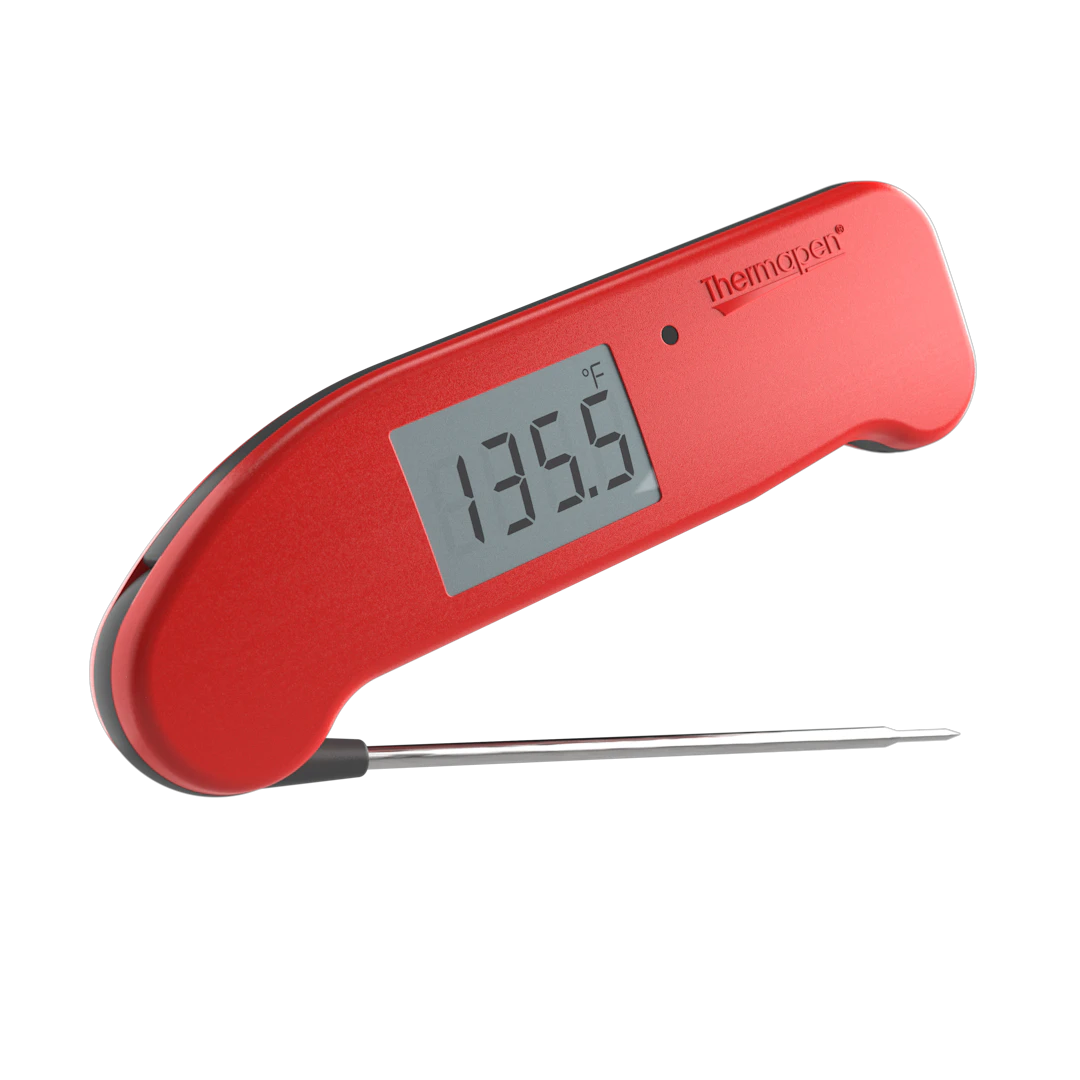
We rubbed the second chilled tenderloin with the herb mixture. Next, we inserted the RFX meat probe into the center of the meat to the immersion line and set the RFX high-temp alarm to 125ºF (107ºC). We placed the meat on a wire rack set in a cookie sheet, and put it into a 475°F (246°C) oven. We used one of the other channels on our TimeStack to start a count-up for the high-oven roast. When each roast’s RFX high alarm sounded, we verified the temperature with Thermapen ONE and allowed them to rest on the countertop to finish carryover cooking. The slow-heat roast was given about 10 minutes of rest, and the high-heat roast was given at least 20 minutes. (Lower heat cooking methods require less resting because the temperature gradients don’t have as far to equalize.)
Results and comparison
The roast in the high oven reached its pull temp in just about 45 minutes, while the tenderloin in the lower-temp oven took much longer, clocking in at about 95 minutes. The time difference was significant, but, as we’ll show, the wait was well worthwhile.
Color, crust, texture
The high-heat roast had a slight crust that impeded the initial knife cut but added very little to the perceived texture. It was beautifully pink in the center but was surrounded by a 1/4–1/2” grey band all around the edge. Once we began cutting, the meat yielded nicely to the knife and was tender and tasty. It was a great roast, one that a cook could put before guests without embarrassment and which would prompt sincere compliments.

But the low-heat roast. Oh, the low-heat roast. The low-heat roast had no substantial crust to it, but was perfectly pink and evenly colored from edge to edge, with no discernible grey band at all. The tenderloin was visibly juicy and yielding under the knife and had a texture that was surprising in its tenderness, verging on softness. You could cut it with a spoon. It was a roast that a cook could present with the full expectation of immediate and enthusiastic praise (as well as fond mentions months later).

Herb rub
One other difference was noticeable aside from the coloration and texture of the meat itself, and that is the effects of the heat on the herb-rub. The herbs and garlic on the high-heat roast had a much paler flavor than the low-heat version. This makes sense, as the high heat drives out the volatile oils and fragrances from herbs, and cooks the garlic more completely. The herb rub on the low-heat roast was more vibrantly herbaceous, with a more pronounced garlicky bite. We will address that in the recipe below.
Of course, just using salt and pepper is perfectly acceptable and delicious for this roast, but if you want the herby flavor, go for it.
Final outcome

Both of these roasts were pulled from the oven at 125°F (52°C). Notice the consistently pink meat edge to edge on the left. This is the difference between excellence (right) and perfection (left). The high-temperature tenderloin is very tasty, but the low-temperature tenderloin is evenly colored, uber-tender, juicy and amazing.
Taking thermal control of your beef tenderloin roast by limiting the thermal gradients and monitoring the temperature results in a stunning presentation piece of the highest quality. And the RFX MEAT and RFX GATEWAY thermometer system makes getting "perfection" easy.
For many things in life, "excellent" is good enough. But for your holiday tenderloin roast, you truly can have perfection. All it takes is a little extra preparation and careful monitoring of your meat’s internal temperature.
References
- Bon Appétit
- Univeristy of Guelph Department of Animal Biosciences, Major Muscles of the Carcass
- J. Kenji López-Alt on SeriousEats.com



0 comments