

You can picture it now. You’re cooking chicken breasts; guests are waiting, but you’re afraid to pull them too soon. You're caught in a trap between pulling off undercooked chicken that could make people sick and leaving it on too long so your guests have to choke down dry chicken that feels like a mouthful of sand. You play it safe and cook the chicken longer than you think is required. Dinner is served, and you take your first bite. Your heart sinks as you drink half a glass of water to force the overcooked bird down your throat. Your guests are safe, but probably don’t find the chicken appetizing. There is good news, though. Safely cooked chicken breast isn’t, of necessity, dry. You don’t have a chicken breast problem. You have a temperature management problem.
Cooking chicken breast has many merits. First, it is high in protein, low in fat, and has virtually no carbohydrates. Second, and perhaps most important, chicken breast is relatively inexpensive and available in every grocery store. Third, it is incredibly versatile, making its way into all sorts of dishes from pasta to paella. We even colloquially say something “tastes like chicken” when we want to communicate that the flavor and texture are non-offensive.
The downsides of chicken breast are relatively straightforward. Because it is low in fat, it is fairly easy to dry out during the course of cooking. Moreover, overcooking the breast results in a stringy, firm texture that makes it seem like your mouth is full of sand when choking down an overcooked chicken breast. The good news is that both of these issues result from overcooking. Simply put, accurate temperature management allows you to create a moist (dare I say juicy) chicken breast with great texture and appearance.
The Problem with the Standard 165°F Recommendation

Before we recommend an ideal temperature, we must talk about why cooking chicken breast is necessary in the first place: pathogens. Steaks can be cooked to a rare or even Pittsburgh doneness without much risk. This is because the most worrisome pathogens in beef are found on the exterior surface of whole cuts. Ground beef means the physical mixing of the outside surface with the internal portion that would otherwise be physically separated from the presence of pathogens. For this reason, the recommendation for final internal temperature for ground beef varies significantly from the recommendation for steaks. With chicken, on the other hand, the whole muscle must be cooked such that the pathogens found internally are killed.
The USDA FSIS recommends a final internal temperature of 165°F. This is because at 165°, pathogens like Salmonella and Campylobacter are killed, essentially instantaneously. On the other hand, many of the chefs and pitmasters with whom I have cooked spurn this advice. Temperatures like 150° and 155° appear frequently as the temperature at which they pull their chicken breasts. Even allowing for carryover cooking, the final temperature almost never reaches the USDA-recommended 165°. So how is it that they can get away with “undercooking” their chicken breasts? No one seems to get sick. The meat is juicy and tender with wonderful texture.
The Pasteurization Paradox: Time vs. Temperature

The reason behind this apparent paradox is that both TIME and TEMPERATURE matter. Just imagine if you walked into a sauna that was 155°. You could last a few minutes before feeling an overwhelming desire to exit. If you were left in for a whole day, chances are tragedy would result. Essentially the same thing happens at a microscopic level. The bacteria begin to die around 136° and die progressively more quickly until at 165° any remaining bacteria die in an instant. Below is a table that lists the time and temperature required to meet the USDA standard of a 7-Log reduction in pathogens. A 7-Log reduction means reducing the bacterial population by a factor of 10 million or 99.99999%. A cook can achieve this level of safety with both time and temperature, according to the table below.
TABLE 7-Log Reduction of Salmonella
|
Temperature |
Time |
|
140°F |
26.2 minutes |
|
145°F |
8.7 minutes |
|
150°F |
2.7 minutes |
|
155°F |
45.9 seconds |
|
160°F |
14.2 seconds |
|
165°F |
<10 Seconds |
ThermoWorks In-House Testing: 155°F vs. 165°F
So, in practical terms, this means that 46 seconds of a temperature of 155°F or higher is sufficient to achieve the same killing power as a peak temperature of 165°F when both measurements are taken in the thickest portion of the breast. Ten degrees of additional temperature can have dramatic effects on the juiciness and texture of the finished product. Our in-house testing using our Gravitas Precision Kitchen scale and RFX™ wireless temperature probe has found that a chicken breast cooked sous vide to 165°F and immediately removed from heat lost twice as much water (12%) as a breast cooked to 155°F for 50 seconds! Double the moisture loss is a big deal when you’re doing everything you can to make juicy chicken breasts.

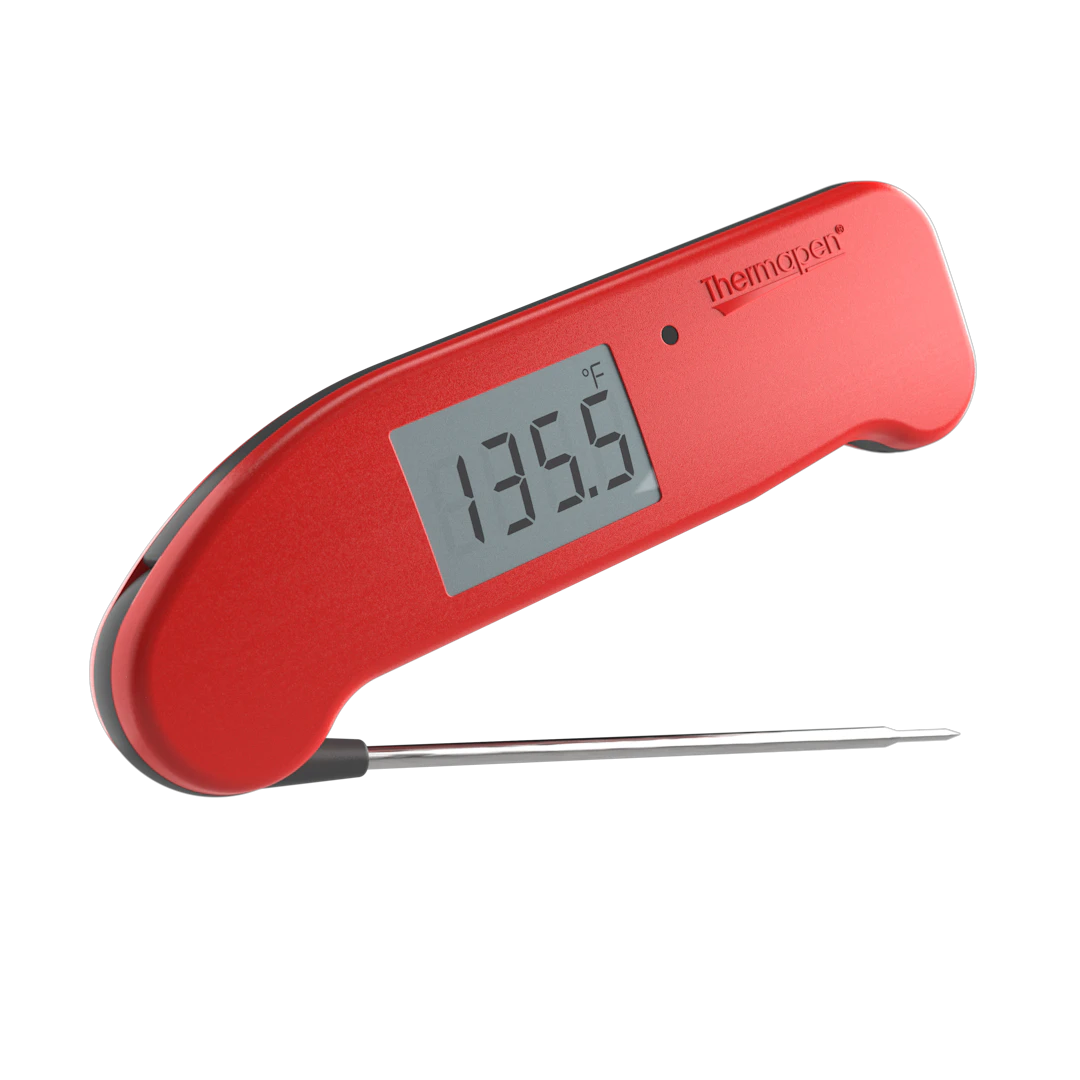
Sous vide chicken that has never touched a grill isn’t the most palatable, but in order to do controlled experiments, sous vide is a tremendous tool. As a result of our real-world testing, we have found that a finished temperature of 155°F, measured with Thermapen One or RFX™ Wireless, achieves the perfect balance of both temperature and texture, and held for only 50 seconds, it achieves the same cumulative effect as a final temperature of 165°F! Thermapen ONE allows you to quickly check multiple parts of the breast, while RFX™ provides continuous monitoring, so you can graph carryover cooking and measure the time-at-temperature that is so crucial for food safety. The time and temperature chart above lists the minimum threshold temperatures. So whether your chicken breast is increasing in temperature (carryover cooking) or decreasing in temperature (resting) after you have pulled it off the heat, as long as it remains above the temperature listed in the chart for the required amount of time, you have achieved the 7-Log reduction required.
Real-World Cooking: Factor in the Margin of Error

In the real world, heat is always flowing, and if you’re using a grill, an oven, a pan, a smoker, an air fryer, or any cooking tool, there will not be absolutely uniform heating. As a result of our blind taste tests, we recommend cooking to 155°F and holding for 2-3 minutes at or above that temperature to ensure that 99.99999% of pathogens have been eliminated. This is longer than the table recommends, but we have discovered that this additional margin for safety does not negatively impact the final result. Ultimately, you have to decide what makes sense for you, but we want to arm you with as many facts as possible to make an informed decision. If you need reliable temperature equipment like Thermapen, or RFX click this hyperlink to get the best price. Gravitas Precision Kitchen Scale will allow you to accurately and precisely measure weights from 1g to 5000g and has a detachable, auto-rotating display that will help you achieve consistent results in your kitchen.

Important Safety Guidelines for At-Risk Populations
It is important to note that the USDA maintains its recommendation to cook chicken breast to a final temperature of 165°F. This is because they are trying to eliminate the possibility of user error and ensure that food can be known to be completely safe. This is especially true for the elderly, children, and those with compromised immune systems. If you are serving food to anyone who is at-risk, it is imperative that you are absolutely sure you are achieving a 7-Log reduction in pathogens like Salmonella. The only way to be 100% certain your food is safe is to follow USDA guidelines. No piece of meat is completely uniform, and no cooking implement delivers completely even heat, though sous vide comes close. Probing a chicken breast where it is thin DOES NOT mean that the breast is uniformly that temperature. Be safe, keep cooking, and don’t overcook your chicken.


0 comments