

Pastrami on rye and the pastrami Reuben are two of the great sandwiches of our age. If you've ever had one, perhaps from a local deli even, you know that there are few tastier things you can eat between two slices of bread. Wouldn't it be nice if you could make them at home? If you had all the pastrami you could eat right in your own fridge? You can! you just have to make it yourself. If you want an easy entry to cured meats or if you're just looking for a new BBQ project to take on, give this recipe for pastrami a shot. Loads of perfect pastrami, cooked just right for sandwiches or anything else, coming up!

Pastrami vs corned beef, what's the difference? What even is pastrami?
Pastrami is made from beef, usually brisket, that is wet-cured in a brine, then highly seasoned with a rub consisting mainly of black pepper and coriander, then smoked for flavor, and steamed to finish. It is often sliced hot and served as a sandwich, though it can also be chilled and sliced as a cold-cut meat.
Pastrami, the word, seems to have first appeared in print in the USA in 1936, making it a relative newcomer to our lexicon. It is most likely derived from Romanian or Armenian, and arrived with Yiddish-speaking Jewish immigrants in the early part of the 20th century. Various dried meats with names similar to Pastirma can be found all around the lands of the Eastern Mediterranean, though most of those seem to be closer in style to South African biltong than the current American pastrami.
The main difference between pastrami and corned beef is the flavor and final preparation. Both meats are cured in a nearly identical way, in a brine containing salt, curing salt, and flavorings. (This curing is a remnant of an age before refrigeration, when a whole cow would have to be slaughtered but could certainly not all be eaten at one time. The curing helped to keep the meat palatable and safe for longer.)
But the similarity stops there. Corned beef gets boiled and served as is, but pastrami gets its coat of spices, a hit of smoke, and then a steam bath to loosen it up. But if you take a core sample from pastrami that is sufficiently far from the smoky, seasoned surface, it will be very hard to tell the difference between it and corned beef.

Why brisket for pastrami?
As hinted at above, making pastrami dates back to Turkish Nomads from the Ottoman empire of the 13th century. More often than not, the meats that would have been made pastrami-style would have been mutton (sheep or goat) rather than beef. Later on, as pastrami was more widely prepared, the traditional cut of meat for pastrami was beef navel or the belly.

Brisket is far more widely available than beef navel, which I have yet to see at the market. Brisket can take the long curing, the smoking, and the steaming of this preparation and still be great for slicing. All that collagen that we break down in the meat as it cooks past 170°F and up to 203°F (from 77°C up to 95°C) becomes gelatin, giving pastrami a great mouthfeel and a unique structure.
If you like leaner pastrami—a question that can cause fierce debate among aficionados—you can use just the flat of the brisket. The flat is leaner, and it is also cheaper than a whole packer brisket. But if you like fattier pastrami, as I do, use a whole brisket, trimmed up, as we do in this recipe.
Of course, a whole brisket is a large piece of meat, and it will take a good solid week to cure. You'll need a second fridge or some serious space management in your fridge to make a whole brisket's worth of pastrami, but we think you will find that it's worth it.
How to make pastrami: 5 simple steps
Making pastrami is far from difficult—there is almost no technical skill that goes into it beyond trimming and weighing—so anyone should be able to do it, and do it well. There are five basic steps in making pastrami:
How to make pastrami:
-
Trim
How much you want to trim your brisket before turning it into pastrami is up to you. We like our corned beef and pastrami a little bit on the fatty side, so we leave a nice 1/4" fat cap on the brisket, or even a little more.
-
Cure in Brine
To adequately flavor the meat and allow the curing salt ample time to do its work, the meat needs to stay submerged in the brine for 7-10 days.
-
Rinse & Rub
After curing, it's important to rinse off the salty curing solution so the final product isn't too salty. Run the pastrami-to-be under cool running water, then pat the meat dry before applying the spice rub liberally to all sides.
-
Smoke
Keep the temperature of the smoker on the low side: 250°F (121°C) is a great balancing point between creating smoke flavor and getting the meat cooked until it reaches 150°F (66°C).
-
Steam
The pastrami is steamed (either on the stovetop or in the oven) until the meat reaches an internal temperature of 203°F (95°C).
1. Trim
How much you want to trim your brisket before turning it into pastrami is up to you. We like corned beef and pastrami a little bit on the fatty side, so we leave a nice 1/8–1/4" fat cap on the brisket. Most brisket flats in the stores are pretty closely trimmed, so control over the fattiness is another reason to do a whole brisket.
If you are electing to do a whole brisket, cut out most of the fat in the seam between the flat and the point. We usually leave the two muscles attached, but carve out almost all of the fat between them. Doing this creates a pretty uniform thickness across the whole cut of meat, making for nice, even cooking.

(You can, and should, take them apart when you start slicing so that you can work with the different grains of the two muscles on their own terms.)
2. Cure in Brine
You can start your pastrami with an uncooked store-bought corned beef, but curing your own always tastes better. Stick to a very traditional curing brine (salt, curing salt, sugar, pickling spices, some garlic).
The salty solution dehydrates the meat slightly, compacting the muscle fibers more tightly, resulting in meat with a fine, soft texture. To adequately flavor the meat and allow the curing salt ample time to cure it, the meat needs to stay submerged in the brine for 7-10 days.

*For more information on curing meat for corned beef, check out our post on Homemade Corned Beef, with Temperature Tips for Success.
Curing Salt (Prague Powder): What is It and What Does It Do?
Salt is the main effective ingredient in a curing solution, but curing salt is also very important. The curing salt we use here, Prague Powder #1, is composed of 6.25% sodium nitrite and 93.75% sodium chloride and is usually colored pink so it isn't accidentally mistaken for regular table salt.
It's the nitrites in the curing salt that give cured meats their characteristic sharp flavor. The nitrites react in the meat to form nitric oxide which prevents fat oxidation, keeping the fat from developing rancid flavors. This same reaction binds to the meat's myoglobin, producing the bright pink/red color of cured meats.
The most important function of curing salts in curing meats, before refrigeration, was the suppression of bacterial growth. Today, we continue to use them for aesthetic reasons—that wonderful cured color and flavor.
3. Rinse & Rub
After curing, it's important to rinse off the salty curing solution so the final product isn't too salty. Run the pastrami-to-be under cool running water, then pat the meat dry before applying the spice rub liberally to all sides. Pastrami rub recipes usually have very strong flavors and are fairly coarse, but don't be afraid of putting a lot on. It needs a good coat.

Because the cure makes the meat so salty, our rub will have no salt in it. This rub is very traditional, but you can modify your rub to fit your tastes as you see fit. Some juniper berries in it, for instance, would be nice. Maybe some coarsely ground dried mushrooms, even?

4. Smoke (and Chill?)
The corned beef is smoked to start the cooking process and to impart delicious smoke flavor. Keep the temperature of the smoker on the low side: 250°F (121°C) is a great balancing point between creating smoke flavor and getting the meat cooked.

We won't be cooking the pastrami in the smoker the whole time, but rather just until it reaches 150°F (66°C). You can use your RFX MEAT attached to your RFX GATEWAY to monitor the meat temp and, if you use the included air probe, either your meat and the pit temp, or two different locations in the meat, as we did. By the time it reaches 150°F (66°C) it should have absorbed plenty of smoke flavor and the bark should be pretty well set. If your bark isn't well set yet, let it go a few more degrees.
This step can easily take 4–5 hours, so depending on your cooking schedule, you might want to take a break here. Unless you have all day to work on this, you can cool the pastrami to room temperature at this point, then wrap or cover it in foil and refrigerate it until you're ready for the next step. We did, and our pastrami suffered no diminution of either flavor or texture.

5. Steam—Why Steam the Pastrami?
Curing the meat in a salty solution for a week draws out quite a bit of moisture, and this last step is traditionally used to gently cook the meat in a humid environment where less water will be lost to evaporation. The pastrami is steamed (either on the stovetop or in the oven) until the meat reaches an internal temperature between 198 and 203°F (92 and 95°C)—depending on how long it takes to get to temp. We used the RFX MEAT again to monitor the temp as it steamed.

Brisket is a very tough cut of meat packed with connective tissue. The best way to break down connective tissue, turning it into succulent gelatin, is to cook the meat at a low temperature for a long time. Creating a high-humidity environment will prevent evaporation and will help us bypass the "stall." Cook the brisket at 250°F, or up to 275°F (121°C up to 135°C) in your oven with the pastrami set on a rack in a roasting pan with a shallow pool of water in it. (Use pre-heated water in the bottom of the pan. You don't want to spend cooking time in the oven just slowly heating a pan of water under your meat.)
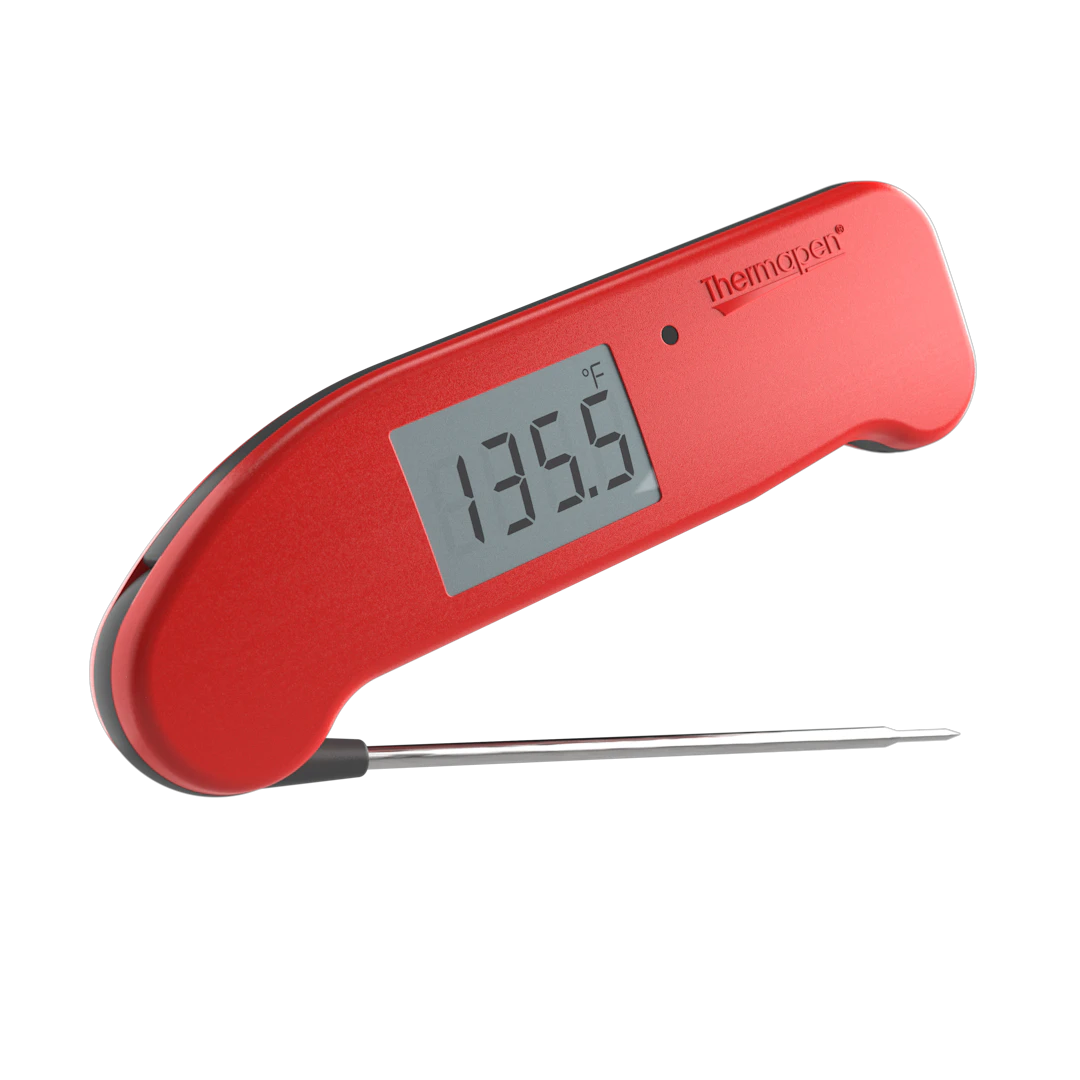
When the high temp alarm in your app sounds, verify the internal temperature with your Thermapen ONE. Make sure you don't see any temps lower than 198–203°F (92–95°C). The Thermapen will also tell you how tender the meat is—a gauge that is almost as important as temp. You aren't looking for a tenderness equal to a BBQ brisket; that tenderness is too tender for slicing for sandwiches like these. You want the meat to feel just a little "tight"—but only a little.
Fair warning here: your kitchen is going to smell insanely good during the steaming process.
Serving and Storing Pastrami
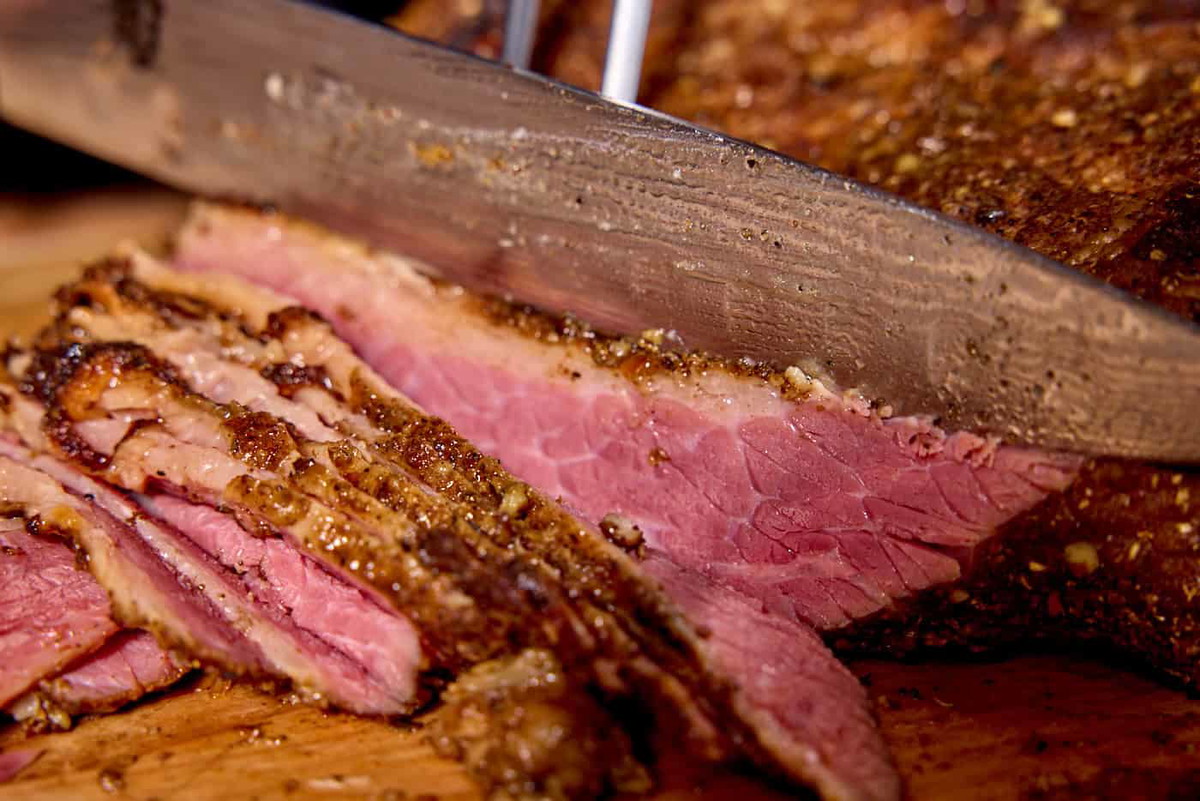
As you can see, making pastrami takes time, but nothing about it is particularly hard. Use your RFX MEAT and your Thermapen ONE to get your temperatures, and thus your textures, just right, and it will turn out marvelously. And now that you have a whole brisket's worth of fresh, high-quality pastrami, what are you to do? You could assemble several loaves of marble rye and pumpernickel, some kraut, swiss, dressing, and good spicy brown mustard, invite some friends over and eat it all right now. No one would blame you one bit! If you want it to last longer than, say, just tonight, you need to store it. You can chill it, then slice it, then freeze it, or you can cut it into chunks and freeze it. Vacuum sealed, it will last ages in the freezer. But if you do decide to put some aside for later, don't forget to eat a good portion of it right away!
Pastrami is a glorious meat if ever there was one, and it's simple to make. If you've ever felt daunted by it, put those feelings aside and clear some space in your fridge for a curing bin, get your RFX MEAT out, and try it. If you even vaguely like pastrami, you're going to love this.
Happy cooking and—even more—happy eating.





0 comments