

I am, either by nature or by nurture, prone to hyperbole—especially when it comes to food. If I don't pay attention to what I'm saying (or typing) I tend toward the grandiose. You may have noticed this in some of my blog articles. So, fully cognizant of that fact, I want to be very clear that when I write this next sentence, it is not, I think, hyperbole. A good burger is a glorious thing. Burgers are our national food, [footnote]This is a point for which I will argue, and argue hard.[/footnote] and because of their importance to our cultural cuisine, we've written rather extensively on the subject. From smash burgers to grilling temps, and from grinding your own meat to stuffed burgers, we've covered a wide swath of burger territory. But until now, we've been silent on one very important part of any burger: the hamburger bun.

A burger that is only so-so can be greatly improved with a good bun, and, conversely, a burger with exceptional beef and toppings can only go so far with a bad bun. And knowing how our readers aren't ones to shrink from a challenge, we knew that bringing you a killer recipe for an amazing hamburger bun would be a good idea.
And this one is a doozy. Created by the literal bread-and-pastry geniuses at The Butter Book, this recipe is amazingly easy to make and gives you results that you will love. Of course, we'll guide you through the thermal steps you'll need to make sure everything ends up properly pillowy and chewy.
What makes a good burger bun?
A good burger bun needs to be able to handle a good burger, i.e. one that is juicy. It should also be able to handle any toppings, from mayo to ketchup to tomatoes and pickles. No one wants a bun that goes all soggy-bottom on you or that disintegrates before you finish eating. A good bun will also be soft enough that you can take big bites comfortably. (Sure, two slabs of crusty artisan sourdough might be interesting, but that is not the burger that any of us are looking for.)
A good bun should be aesthetically pleasing, after all, presentation is a huge factor in culinary enjoyment and a wan, pale bun just won't get people as excited as one that is burnished golden brown. And it goes almost without saying that a good bun must be delicious in its own right.

How to make a perfect hamburger bun
That list of characteristics can seem a little daunting. But making a perfect bun that checks all of those boxes isn't any harder than making any other bread. Let's take a look at what it takes to get a bun that does what we want it to do.
Sturdiness
First, a bun that is sturdy enough to take the juice of a burger can be made by using high-gluten flour and developing that gluten very well. We get that in this recipe from good quality bread flour that we knead in a stand mixer for a full 12–15 minutes. The resulting gluten network is strong enough to provide the strength and structure (and perfect chew) we need.
Tenderness
But will such a well-developed high-gluten dough be tender as well as strong? It will if we proof it correctly. The dough undergoes an initial proof on the countertop at room temp for one hour, then is shaped (re-forming some of the gluten) and proofed in a warm oven or cooler for another hour and a half. (More on the shaping below.) You want to be careful here. A proof that is too hot will cause the dough to rise too quickly, ruining some of the gluten structure. Using a ChefAlarm to track the temperature of whatever proofing box you use will help you get the very best results. Set the high- and low-temp alarms on either side of 80°F (27°C), then regulate the temperature of the box if it goes too high or too low. If you let it rise at the right rate, the gluten will help your bun stay strong.

Golden-brown goodness
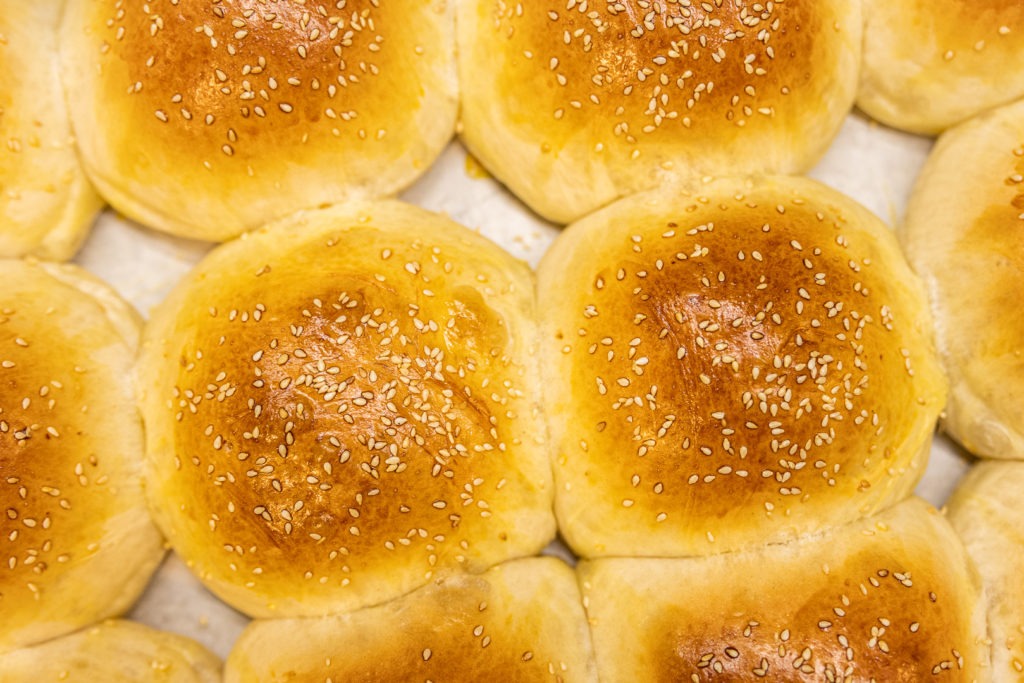
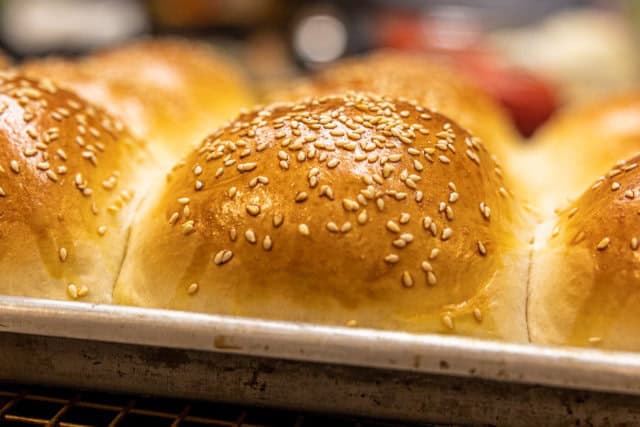
So much for the bun's structure, what about the aesthetics? To make the buns beautiful, we give them a double coating of egg wash—one coating before the final proof, another right before baking— to give them that beautiful, dark gold sheen. Along with the second coating, we also strew the tops of the buns with sesame seeds, which not only look nice but also give the burger a nutty, complex flavor that varies the flavor. They add topography to the flavor landscape of the bun.
Flavor
As for flavor, well, we wrap that up pretty soundly by making a rich dough bun with whole milk, egg, butter, and a little sugar. You'll have to restrain yourself to save these buns for the burgers! But of course, even the best recipe will be bad if you undercook the buns. Rich dough breads have a finish-temp of 180–190°F (82–88°C), which we can check during the cook with a fast and accurate instant-read thermometer like the Thermapen ONE. Perfectly done bread is tastier bread!
Shaping hamburger buns
I mentioned in the above section that the buns are shaped, but how is that done? It's surprisingly easy, once you get the hang of it. First, the big dough ball is cut into smaller dough balls, each about 80 grams. You should get about 12 from this recipe. Place a chunk on an un-floured surface, preferably with the freshly-cut (stickier) side down on the counter. Cup your hand and place it over the ball so that your hand is just touching the top of the dough ball. Then move your hand in a small circle, dragging/rolling the dough ball around inside the "cup." You'll feel the ball start to become more spherical, and then it will rather suddenly coalesce into a firm, smooth ball. Place it on a parchment-lined sheet pan.
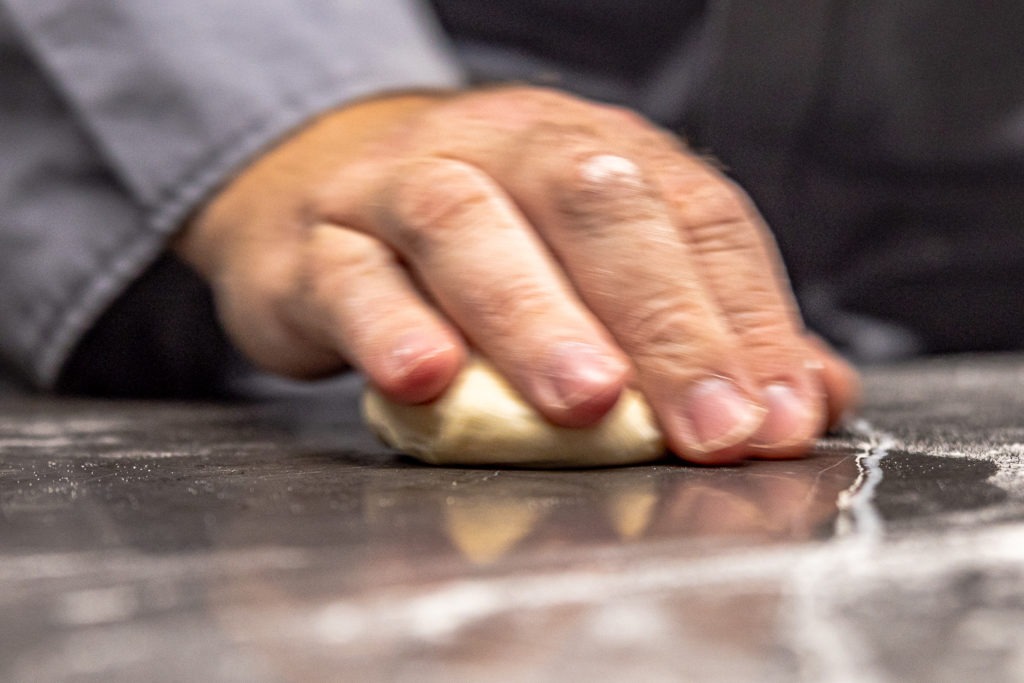
Repeat this rolling process with all of the balls, then top the dough balls with another sheet of parchment and squish them so they are flattened with another sheet pan. The resulting discs will not be very big around, and they certainly won't be very flat (thanks gluten). Don't worry, they'll proof up perfectly.

If you're as serious about burgers as I am, and I assume you are, then you really need to try this recipe out. Once you start making your own buns, you'll never want the bagged grocery store variety again. If you can get the best buns with just a few hours of work, why would you want the sad, soggy ones? You wouldn't!
Take up the challenge. Grind your meat, make your buns, fry up some fries, maybe even cure your own bacon. Make your burgers! If you can find a better burger out there in the world, you must absolutely write in and tell me about it. But don't worry. You won't. Yes, doing the whole thing from scratch is a lot of work, but if you want a glorious example of what is already a glorious food, then this is the best way to get it. With the aid of your Thermapen your buns and your burgers will truly be their best.

Want to learn to bake like a pro? Our friends at The Butter Book can help! Founded by world-renowned chefs Sébastien Canonne M.O.F & Jacquy Pfeiffer of The French Pastry School, The Butter Book is an online baking platform with video lessons designed to inspire sweet and delicious creations in the kitchen. Subscribe and you'll have access to over 200+ baking videos led by pastry professionals, tried and trusted recipes you can learn at your own pace, and a platform centered around a community of home bakers. This isn't something we're getting paid for, the benefit is the knowledge our customers will be gaining!


0 comments