

Salmon is America's favorite fin-fish. The average American consumes about 2.4 pounds per year. Shrimp is the #1 favorite seafood, coming in at over four pounds per year, which is saying something, considering that 56% of us only eat any seafood (including canned tuna) twice a month. So those that eat seafood are eating a lot of salmon!
Well, who can blame them? It's delicious, it's readily available, and it stands up to many and various cooking techniques and flavors. Here, we'll talk about grilling salmon on a cedar plank—a fun and nearly fool-proof way to get your salmon cooked just right every time. Let's jump in!

Grilling Salmon: What's With the Cedar Plank?
It may seem strange to cook a piece of fish directly on a wooden plank. Why do it? For two reasons: flavor and control.
Cedar Plank Flavor
Cooking salmon on a cedar plank tastes good. Have you ever smelled freshly sawn cedar or tossed a piece of cedar onto a crackling fire? It smells amazing. By cooking salmon on a cedar plank you transfer those natural aromatic oils from the wood into the fish, giving it a woodsy, wild flavor that you just can't get anywhere else.
Cooking salmon on a cedar plank is popular in Native Pacific Northwest cookery as well as in Finnish cookery. Though the method differs in the two regions, it is used in both cultures for flavoring the fish. I think that if you give it a try, you'll also love the unique, woody flavor that the method imparts to your fish.

Cedar Planks for Heat Control
The other advantage to the Pacific Northwest method of cedar plank cooking is heat management. Unless you do everything just right when you grill salmon, it is easy to have the fish stick to the grill or overcook in the direct heat. By placing the salmon on a wooden plank, you create an insulative barrier under the fish that will help keep it from overcooking.
Of course, you don't just pick up a fence slat from your local big box hardware store. Your cedar plank needs to be made of untreated wood—we want natural essential oils getting in our food, not chemical treatments for weatherproofing! You can often find the proper slats at good butchers, many grocery stores, or your local BBQ specialty store.

And you don't just slap some fish on there and throw it on the fire (though that isn't far off). You need to soak the wood for a couple of hours before you cook. Soaking prevents the plank from bursting into flame as soon as the fire licks it and it creates a heat-mitigating atmosphere in its immediate vicinity, i.e. around your fish.

Critical Temperatures to Cook Salmon
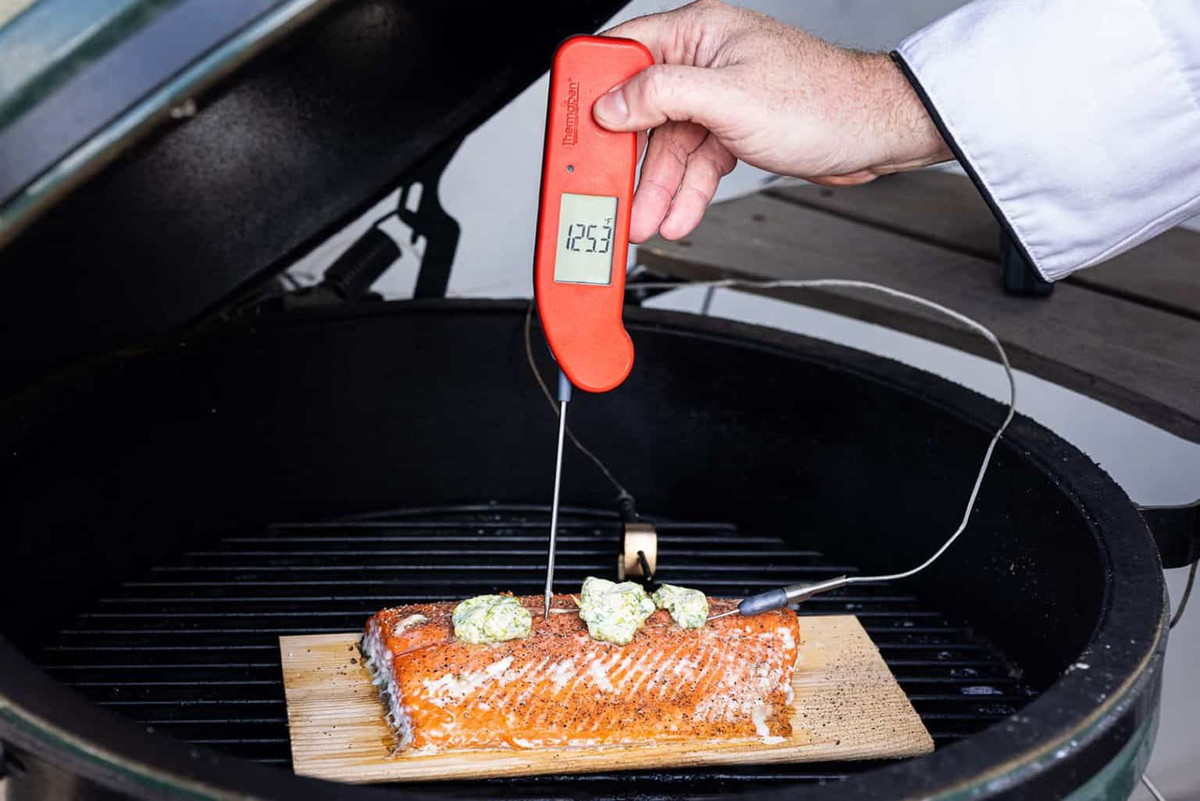
According to Susie Bulloch at HeyGrillHey.com, you'll want to heat your grill so that it's in the 375–400°F (191–204°C) range for cedar-planking salmon. We set up our Kamado-style cooker with Smoke X™ and Billows™ BBQ temperature control fan and set the target temp to 375°F (191°C). (Or, if you have it, use RFX MEAT™ and RFX GATEWAY™ to monitor your cook and control your fan!) When it was time to cook, we put the cedar plank and fish right on the grill grate without the deflector plate, probed our salmon with a 2.5" needle probe (perfect for thin and delicate cuts like fish), closed the lid, and let it cook.

The USDA says that salmon needs to be cooked to an internal temperature of 140°F (60°C) for food safety. If you have any immunity issues, that's a good idea, but for the tastiest salmon, most chefs call for a pull temp of 125°F (52°C). We set our high-temp alarm on our Smoke X for 125°F (52°C) so that we could get the best texture on our fish.

How long the salmon must cook depends on its initial temperature as well as its size and thickness. Our piece of wild-caught sockeye took about 25 minutes to cook. When the alarm sounded, we verified the temperature with our Thermapen® ONE and dotted the fish with some lemon-dill compound butter.
It was very tasty.
Whether you're eating salmon because you're trying to be healthier or just cooking it up because it's dang tasty, this method is a great way to go. It's a fantastic way to let the quality of the fish itself sing out. With the temperature monitoring and critical temps we've provided here, it's incredibly easy to get right. And it's really good for any time of year—heck, we cooked it in mid-January.
We hope you give it a try soon. Make it, share it with a friend, and show them what you've learned. They'll be happy you did, and so will you.
0 comments