

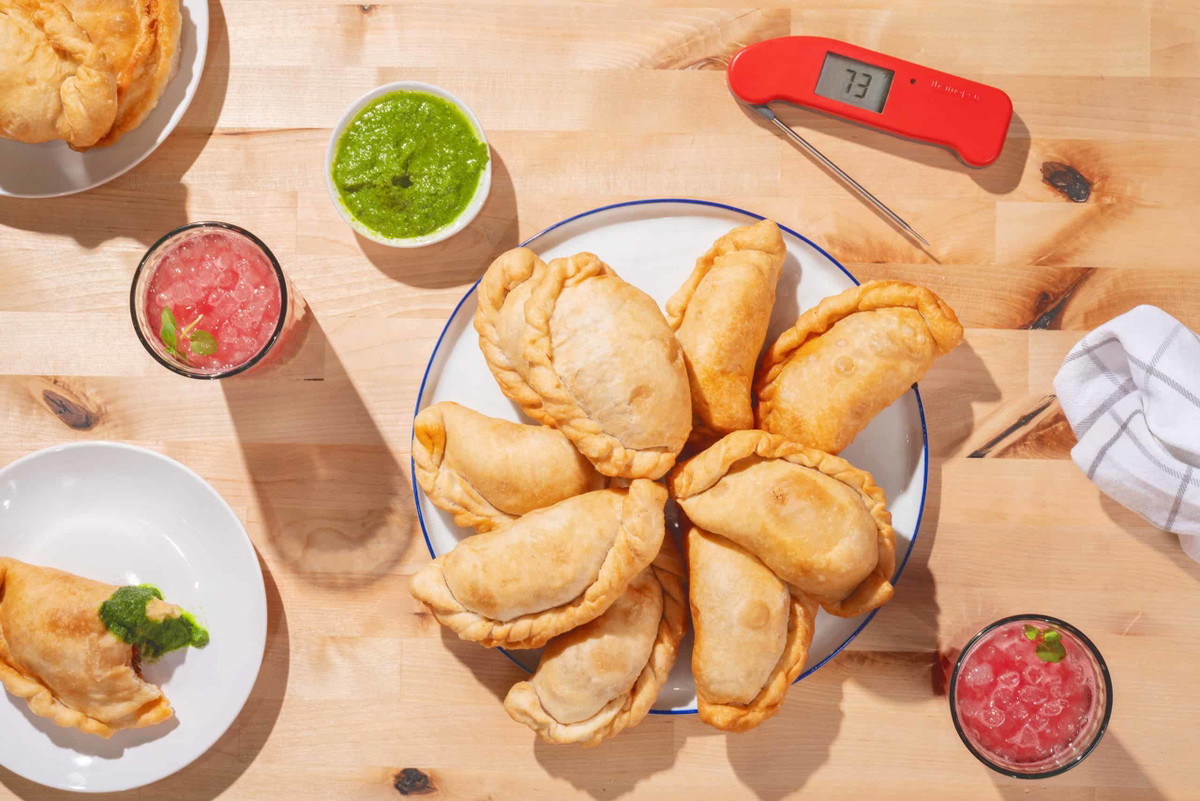
Can we agree that hand pies are an absolute culinary treasure? Whether the English pasty, the Amish fried pie, or the Latin American empanada, they’re all good. In fact, today we’re going to take a look at empanadas. To be more specific, we’re going to look at fried beef empanadas with an Argentinian-style filling. Yum!
In this post, we’ll look at the filling, the dough, folding and stuffing, and the best oil temperatures for frying these beauties. What we end up with is pure joy. Let’s get to it!

What makes a good empanada
Empanada fillings
Empanadas are wonderful for their versatility. By that, I don’t just mean that they are super packable, and can easily be taken on the road, but that the empanada itself can be good for any kind of filling you want to through at it. Yes to seasoned ground beef. Yes to shredded chicken. Yes to ham and cheese, yes to diced apples with cinnamon, yes to pork barbacoa, yes to all your heart’s culinary desires. Once you’ve mastered the dough and the filling process, you have the whole world in the palm of your hand.

I love the Argentinian-style ground beef filling. It incorporates a plethora of spices as well as onion, red pepper, raisins, and—to crown the whole thing—a little bit of green olive. The spices complement the beef, the sweetness of the raisins balances the spices, and the sharp, sudden brine of the green olive keeps the raisin sweetness from overpowering. It’s a masterclass in balance, and it’s all shoved into a simple crust for portability. Fantastic. (We took inspiration from Gaby Melian, formerly of Bon Appetit, for the filling.)
Good empanada dough
But given your choice of fillings, what else makes an empanada good? The crust, of course. After all, the crust is the pan (Spanish for bread) in the empanada. You want a dough that is good enough to want to eat on its own. Chances are good that the last bite of your pastry will mostly be crust, you may as well make it enjoyable! Though there are many styles of empanada dough you can use, here we opt for a rich dough that stretches easily. (Big shoutout to Curious Cuisiniere, from whom we modified our dough recipe.)
Mixing, kneading, portioning, and rolling out the dough-discs can cause the dough’s gluten strands to tense up, get tight, and resist. To counter this tendency, we start with all-purpose flour, which has a lower protein (gluten) content. Then, we mix the dry ingredients with oil (butter in this case, though lard would also work well) to coat the flour granules with fat before we introduce the water and mix until it’s smooth-ish. This is, in essence, the biscuit method—and it pays off. The dough is easily extensible and pliable while not wanting to shrink back into a ball at the least provocation.

Filling and sealing empanadas
The best filling and the best dough won’t do you any good if your empanadas won’t stay closed when floating in fry oil, and won’t matter much if your dough is oil-logged and soggy after frying. To prevent these culinary disasters, you need to seal your empanadas well and fry them at the right temperature.
How to seal your empanadas
Sealing empanadas is the most difficult part of the cook, but it’s really not all that bad. There are a few things to look out for, though.
For instance, it’s tempting to overstuff the dough, but go easy on the filling! The filling will look small on the dough, but it will end up being more than you think, and overstuffing causes filling blow-outs in the oil. Two to three tablespoons of filling will be plenty.
Also, you should try to get as much air out of the pocket as you can. Excess air will expand in the hot oil and make a large bubble that makes it hard to turn and cook the empanadas. You won’t be able to get rid of all the air, obviously, but just try to press the dough down close to your toppings to eliminate gaps.
Roll out your empanada dough into a disc about 6″ in diameter and place a small heap of filling in the center (not more than about 3 Tbsp). Fold half the disc over the filling. Press the dough together along the seam and pick up the empanada in your left hand. With your right hand, crimp the bottom corner of the dough in on itself, then make another fold that overlaps it. Continue, folding and crimping, all along the edge. Set the completed empanada aside and make the rest of them.

Frying temperature for empanadas
We’ve already established that the crust is the key to a good empanada, but the key to a good crust for a fried empanada is temperature control. Frying at 350°F (177°C) will result in an empanada that is crisp-flaky, and light, not oil-logged. Old recipes will tell you to pinch a piece of dough and drop it in the oil to see if it sizzles, but sizzling happens at a wide range of temperatures, not only at 350°F (177°C), so using a thermometer to gauge the temperature is super important.
If you have a ChefAlarm®, you’re well set—its high- and low-temp alarms are perfect for adjusting the heat to keep it in range. In fact, we consider ChefAlarm to be the best thermometer for deep frying! But if you don’t have one (yet) you can certainly use your Thermapen® ONE to monitor the oil temperature. Keep it close to hand and check the temperature often, adjusting your heat to keep it as close as you can to the target temp.

These empanadas are delicious. And once you get the sealing operation down, they’re really not hard to make. Double the batch—triple it!— and freeze some for later, or just make enough for your family tonight. They’ll love it, and so will you. This dough recipe works well for sweet or savory empanadas, so you can mix up the recipe however you see fit. Just be sure to monitor your fry temps so you don’t burn your beauties or sog them with oil. Give them a try this weekend, you’ll be glad you did!
0 comments