

Who doesn't love tender, juicy, melt-in-your-mouth, smoked pulled pork? But traditional cook times for this BBQ staple can have you up in the wee hours of the morning checking your smoker. Thanks to accurate temperature tools and careful monitoring of the temperature of both the smoker and the meat inside it, we were able to cut 7 hours off of traditional smoking times while preserving all of the flavor and most of the moisture and silky texture.
(By the way, if you're interested in a Kansas City-style treat, check out our post on making sliced BBQ pork shoulder.)

History: Why is it Called a Pork Butt?
Pulled pork comes from the pork butt, but where does that name come from, anyway?
The cut is nowhere near the hog's rear end (the anatomical "butt" of the animal is actually the ham)—the pork butt is a sub-primal cut from the pork shoulder. The name, it turns out, comes from the name of a barrel.
In the early nineteenth century, New England was a pork-production powerhouse. The shoulder was the least desirable cut and was routinely packed into wooden barrels and shipped out across the country for processing. Barrels came in different sizes (the hogshead, the tierce), but the ones pork shoulders were packed into were of the size officially known as the "butt." These 126-gallon (477-liter) barrels filled with pork came to be known as "Boston Butts," a term that was soon applied to the meat inside.
Pork Butt Temperatures:
But let's get back to the matter at hand: making great pulled pork. The USDA recommends that pork is cooked to an internal temperature of 145°F (62.8°C) for food safety. But every pit boss worth their salt knows that cuts rich in collagen, like pork butt, need to be brought to much higher temperatures (195-205°F [91-96°C]) to properly break down the connective tissues. What's more, dissolving the collagen into gelatin and successfully rendering the fat usually requires lower sustained temperatures during the cook than do turkeys or roasts. This is what gives the resulting pulled pork meat its signature moist and silky texture.
The art of smoking meat is all about taking tough cuts of meat such as pork shoulder and brisket and turning them into tender, juicy, flavorful masterpieces by controlling low cooking temperatures over time.
Why Low and Slow?
The anatomy of this cut is what determines its optimal cooking method. It is a heavily-worked muscle on the animal, and because of the load-bearing activity of the shoulder muscle, the protein fibers are held together with a tough web of connective tissue. Though the butt starts tough, those who take the time and effort to tenderize it are amply rewarded with a deep, rich flavor and a succulent texture.
Pork shoulder is the lead of culinary alchemists, just waiting, itching to be turned into gold.
—The Food Lab, J. Kenji Lopez-Alt
"The Most Traditional Method" typically recommends keeping the internal air temperature of your smoker at about 225°F (107°C) during the cook. But at that temperature, it can take as long as 18 hours to bring the internal temperature of the pork up to its target of 195–205°F (91–96°C).
But is it possible to achieve similar results with a higher smoker temp?

Cooking pulled pork faster
Rather than cooking our pork butt at 225°F (107°C) and leaving it unwrapped the whole time—strictly speaking, the most "traditional" method—you can get almost identical, but much faster, results by turning up the heat and wrapping your pork. To demonstrate, we took a bone-in pork butt and cooked it with our RFX Starter Kit to see how long it would take.
Setting up the smoker
After seasoning the pork butt well, we inserted our RFX MEAT wireless probe up to the recommended immersion line, angling the probe so that the four sensors would be in the vicinity of the center of the meat. We attached RFX GATEWAY to our Billows BBQ Control Fan and preheated our kamado-style cooker to 300°F (149°C) with the included air probe checking the temps. Then we put the pork butt in the smoker with the deflector plate in place.

First phase of smoking
We knew we were going to wrap the meat eventually (more on that in a minute), but we didn't want to wrap too soon, or we'd compromise bark formation. Experience and tradition both have taught us that by the time we approach the stall, the bark ought to be well set. So we set the high-temp alarm to 160°F (71°C). We knew that the bark would almost certainly be set by that temp, so we put that in as an outer-limit for checking the progress.
Probe Placement: The probe for the meat was placed with the tip in the center of the butt. Any piece of meat is only as tender as its toughest part, so we needed to make sure the thermal center of each cut was reaching our desired temperature.

Wrapping the pork butt, overcoming the stall
Even with careful attention to smoker temps, any piece of BBQ meat will still experience "the stall." When you smoke these collagen-rich cuts, the internal temperature of the meat will eventually plateau—or stall—at around 160°F (71°C). In fact, it can even drop slightly.
Aaron Franklin explains it well:
The stall happens as a result of something called "evaporative cooling." It's the same mechanism that allows sweat to cool down the body. Sweat works like this: when moisture sits on the surface of the skin, it's evaporated by heat energy given off by the body. So when the water changes from liquid to gas form, it absorbs a significant amount of heat energy … creating a cooling effect …. Inside a cooker, the piece of meat is sort of sweating too. It's losing moisture to the air in the form of evaporation. Interestingly, air turbulence and humidity has a greater impact on evaporation than actual temperature—and since there's a huge amount of air movement in a smoker, the evaporation is quite significant.
– Aaron Franklin, Franklin Barbecue: A Meat-Smoking Manifesto
If you're cooking "traditional style," you have to practice patience when you hit the stall. It takes time for the evaporative cooling to run its course and the temperature to begin rising again, melting the collagen into gelatin. But we don't want to practice that much patience! So we keep the higher smoker temp we were at already, but wrap the pork when we start to reach the stall. (In this case, we checked the bark at about 155°F and found it sufficiently set to wrap. Give the surface a light scratch and see whether the bark feels well-attached to the meat, or whether it scratches off easily.)
For extra flavor, we didn't just wrap the butt in foil; we put it in a foil pan and added a mixture of butter, apple juice, and vinegary hot sauce—all preheated to a boil, for thermal and time reasons. Then we covered the top of the pan with more foil, crimped it together, and put it back in the smoker. Our RFX MEAT had no problem communicating through the foil and the walls of the kamado, so we continued to use it to monitor the temperature of the meat as we kept cooking. Of course, we changed our high-temperature alarm at that point, aiming for 203°F (95°C)—which was easily done in the free ThermoWorks App.

Resting and shredding the pork
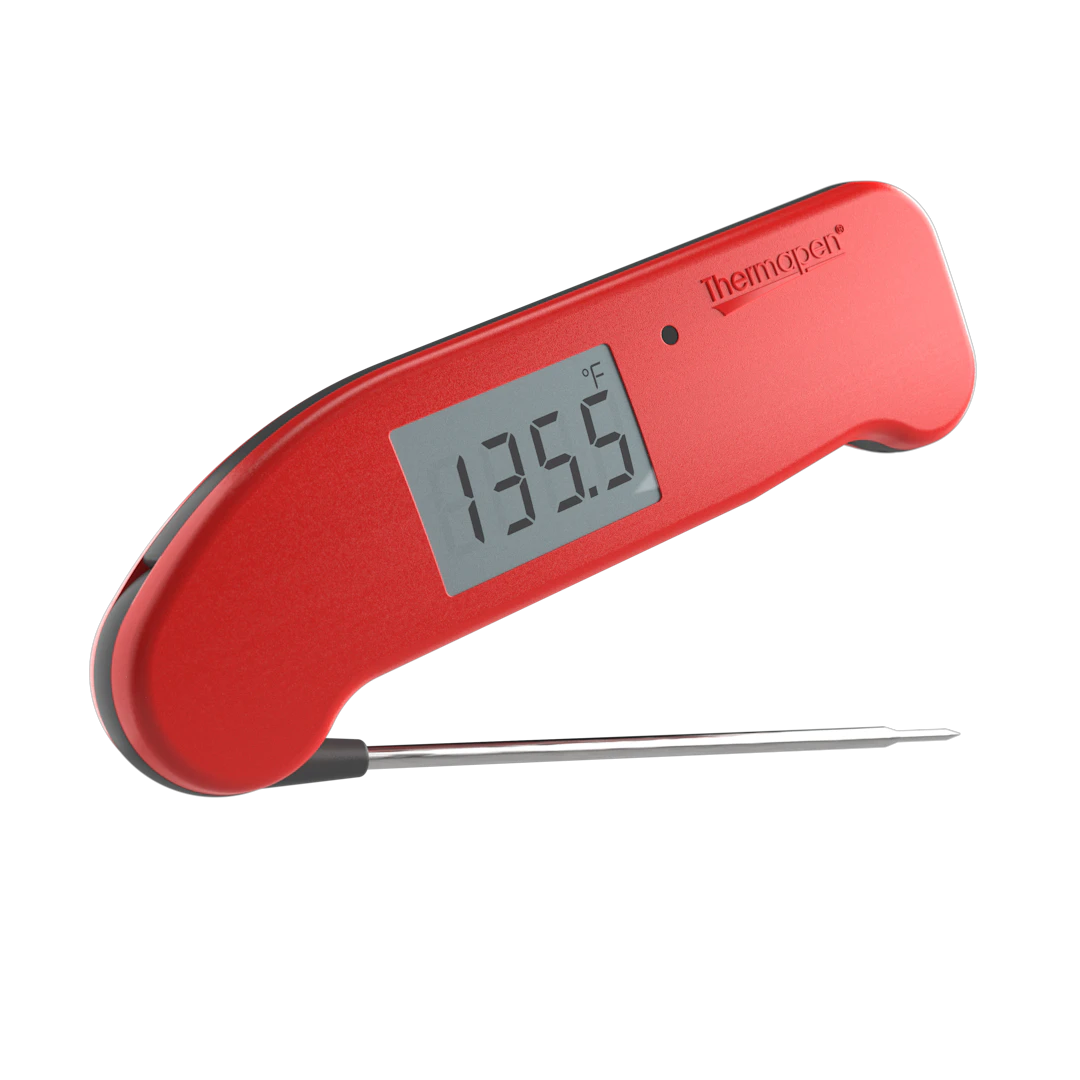
When the alarm sounded in our app, we verified the temperature with our Thermapen ONE and found that we had, indeed, reached an all-over temperature of 203°F (95°C). How long had it been? About 8 hours. The last time we cooked a butt naked and slow, it took a whopping 16 hours!

But temperature alone is not enough to ensure shreddy tenderness. Time at temperature is also important. So we left our pork in its juicy pan (now filled not only with the apple juice, butter, and Frank's, but also with a substantial amount of rendered pork fat and captured pork juices), covered, for a couple hours. During this time, the collagen continues to melt, but the meat doesn't get any additional heat put into it. The result is a silkier, still-moist texture at the end.
Shredding: After resting, our pork butt was ready to fall apart on its own. The blade bone fell out readily, and the meat took no effort to shred. It was beautiful. Once it was shredded up, we drizzled in the liquid contents of the foil pan, adding more rich liquid and deeper flavor to the meat. And how was it?
It was delicious.

There was very little observable difference between our faster pork and a traditional low-slow version. If we had let it rest another hour, it would have been even closer to the "original" style.
Our Recommendation: The true low-and-slow smoking process certainly has its place, but for a backyard barbecue, we find the hot-and-fast process really fits the bill. Most people likely won't detect the subtle differences in texture, and the time savings were significant. If you're smoking your pork butt for a family reunion or other similar event, it may well be worth it to save yourself some time and crank up the heat in your smoker.
Keys to Success: Once again, here are our keys to tender and tasty pulled pork:
- Rinse and pat dry your pork butt.
- Apply your favorite dry rub.
- Preheat your smoker: 300°F (149°C) for this expedited technique. Use RFX MEAT and Billows to set and monitor the temperature of the smoker.
- Place the tip of an alarm thermometer probe (like RFX MEAT) in the center of the meat (you can easily find the cold center of the meat with an instant-read thermometer like Thermapen ONE).
- Set the internal target temp for the meat to 160°F (71°C).
- Cook until the bark sets or the high-temp alarm sounds.
- Wrap the pork when the bark is set and reset the high-temp alarm for 203°F (95°C).
- Pull your pork from heat when it reaches its target and let it rest.
- Shred, add liquid, and serve—no BBQ sauce needed!

Resources:
The Food Lab, J. Kenji Lopez-Alt
Franklin Barbecue, Aaron Franklin




0 comments