

There's nothing quite like a good braise. All those vegetables, that rich and unctuous sauce, the fork-tender meat—who could resist? Not us! And especially not if the meat in question is lamb shanks. Lamb shanks bring all the rich, fatty goodness of a braise together with the warm, comfortingly exotic taste of lamb. And we love it! In this post, we aim to give you the critical temperatures as well as some other tips to help you create a braise worth looking forward to. This dish is a kind of big-delicious you don't get every day! Let's get into it.
What are lamb shanks?
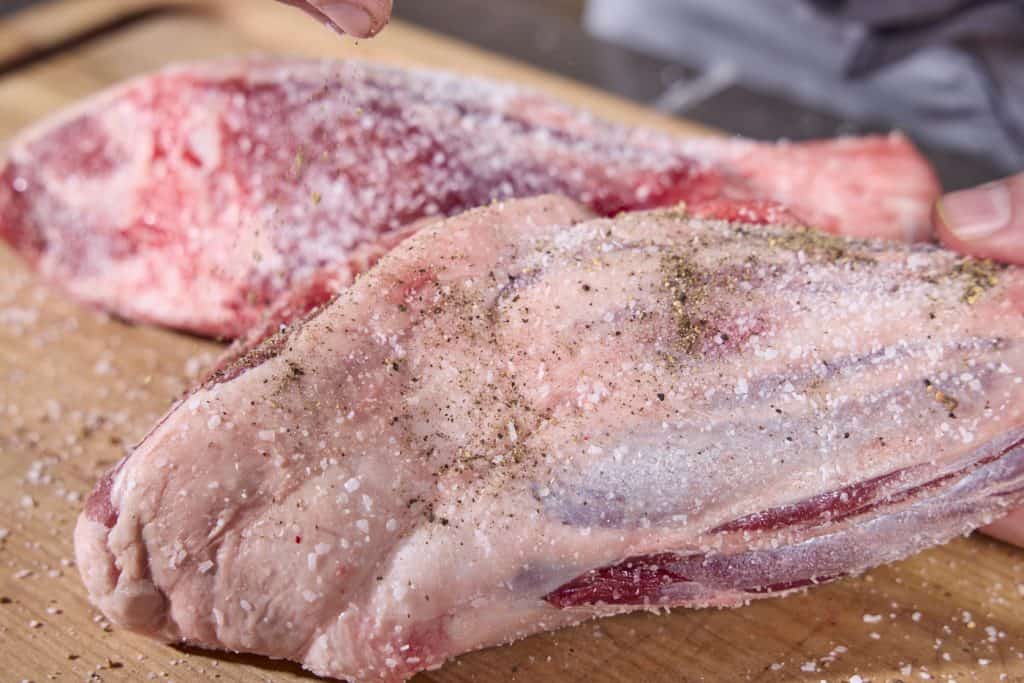
The shank is the shin. It is the bottom section of the leg of a quadruped that is found between the knee and the ankle. In this case, that "shin" comes from a sheep—preferably of a breed bred for meat, not wool—that is less than a year old.
Because shanks are used for walking, they are tough by nature, but also very flavorful. The toughness comes from the high proportion of collagen and other connective tissues in the leg. For that reason, this is a cut that is best cooked via slow, moist cooking methods, i.e. braising.
Why braising works and how this braise will go down
Braising is a cooking process by which tough food—usually cuts of meat, but also some fruits or vegetables—are cooked with some liquid, though not enough to cover them. A flavorful liquid, often imbued further with aromatics, comes not more than halfway up the side of whatever is being braised. The braising vessel is covered and cooked either on the stovetop or in a moderate-to-hot oven. This creates a humid environment that is all basically one temperature [footnote]isotropic, if you will[/footnote] and is not conducive to evaporation.
That's a pretty good technical definition, but why do we do it? Why does it matter? It matters because of the collagen that is so plentiful in lamb shanks, as well as in so many other cuts of meat.
Collagen breakdown
We have written plenty on this blog about collagen breakdown, but it never hurts to review. Collagen is one of the body's most abundant connective tissues. It holds muscles together, giving them support in their work. But if you heat it to temperatures above 170°F (77°C), it unwinds, unravels, and melts into gelatin. Collagen is nearly impossible to chew through when there is enough of it, but meat that is suffused with gelatin is pleasant, tender, and fun to eat.
Braising provides an environment where collagen breakdown is particularly easy to achieve. In a 100% relative humidity environment like a simmering Dutch oven, there is no evaporative cooling in the meat, so it can push through the temperature range where it would normally stall out and go right on to collagen melting.
Depending on how much collagen you melt into gelatin, your meat can go from tough to tender to fall-off-the-bone. And what's more, the sauce that you get from braising has a richer, deeper texture from all of the dissolved gelatin in it. It's quite spectacular.
Temperatures for braising lamb shanks
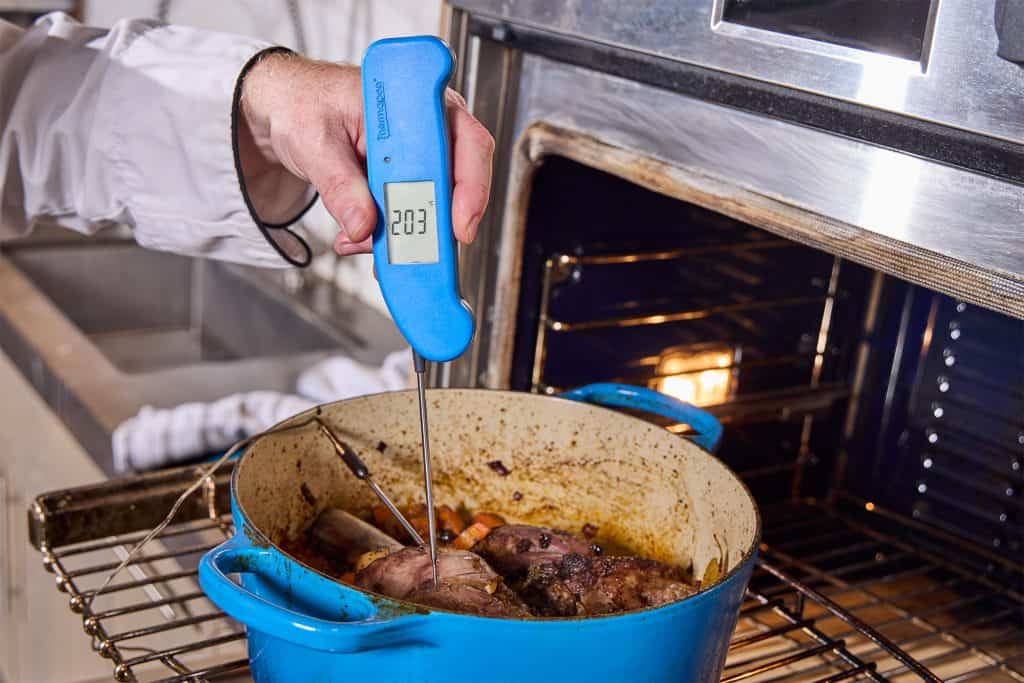
To braise the lamb shanks, use your oven set to 350°F (177°C). Get the braising liquid up to a simmer before putting the pot in the oven, so you don't have to waste time inefficiently heating it up in the oven. Insert a probe, attached to your ChefAlarm, into one of your shanks and set your high-temperature alarm to 203°F (95°C). By the time the meat comes up to that temperature at that cooking temp, enough of the collagen will have melted to make your shanks fork-tender. It should take about 90 minutes.
That may not seem like a long time if you're used to rendering collagen for barbecue, but this cut of meat is much smaller than most barbecue, and the animal is younger, with less developed collagen. (A mutton shank would take longer to tenderize, even though it's from the same breed of animal.)
When the ChefAlarm sounds, verify the temperature with your Thermapen ONE, looking for temperatures lower than your target. Also, feel for a tender texture with its probe.
Flavors: what we did and what you can do for your lamb shanks
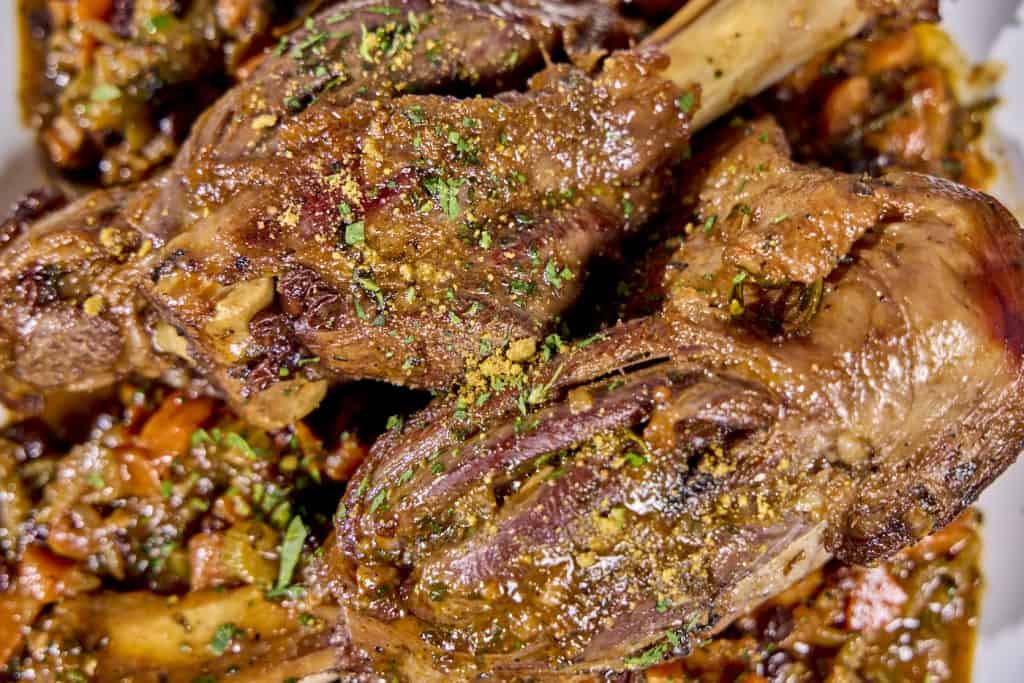
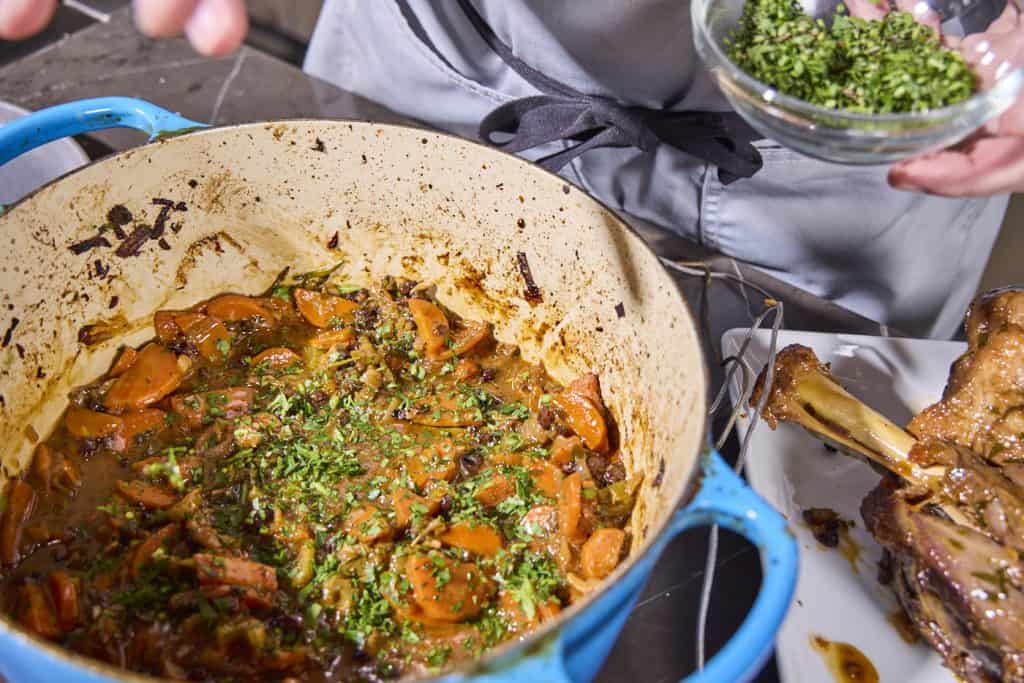
We kept this braise fairly classic: onion, carrot, celery (a combination called mirepoix [ME-REH-PWAH] in kitchen parlance), some garlic, bay leaf, beef stock, and some red wine. But we also gussied it up a bit with some raisins (the sweet is amazing with all this savory), some harissa, and some ground pistachio. The harissa was not enough to make it spicy, just to add interest, and the pistachio, added after cooking, was a flavorful way to thicken the sauce a little bit more.
But you can do yours however you want! Make it Chinese or Mexican. Make it like you would a curry. The temperatures and times hold true no matter how you make it yours.
We hope you give this cook a try! It made at least one person who tried it decide they might like lamb after all, and we can't wait to make it again. Happy cooking!





0 comments