

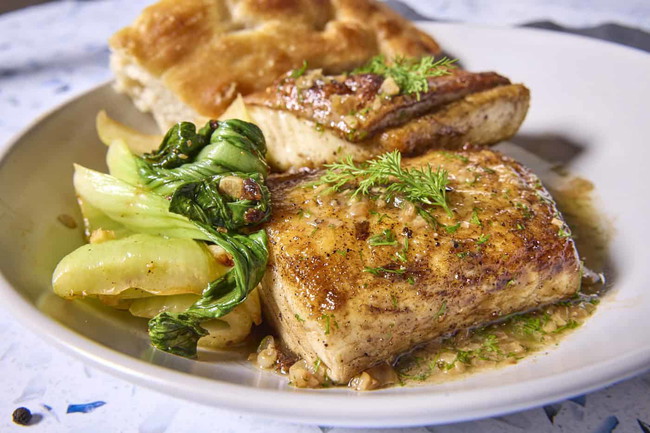
Cooking fish is, frankly, a little scary for most cooks. Fish overcooks easily, and when it is overcooked, its quality degrades more steeply than, say, beef. This is a shame because a great piece of fish, like the pan-seared halibut we'll be covering today, makes a fantastic meal.
Here, we aim to dispel any fish-fears you may have. We'll provide you with the critical temperatures and methods you need to make a restaurant-grade dish you can be proud of. Let's dive in!
Fish protein basics
Though we will be comparing this particular piece of fish to a steak later on, it's important to note that fish protein behaves differently than "land" proteins do. Fish are, figuratively as well as literally, a whole different animal when it comes to how their proteins work. Harold McGee, of course, can tell us the differences:
Fish have a more delicate texture than the flesh of our land animals. The reasons for this are the layered structure of fish muscle, and the sparsneness and weakness of fish connective tissue...
Fish connective tissue is weak because its collagen contains less structure-reinforcing amino acids than beef collagen does, and brecause the muslce tissue also serves as an energy store that's repeatedly built up and broken down, whereas in land animals it is porgressively reinforced with age. Meat collagen is tough and must be cooked for some time...to dissolve into gelatin, but in most fish it dissolves at 120 or 130°F /50–55°C, at which point the muscle layers separate into distinct flakes.
Harold McGee, On Food and Cooking, pg. 191
Knowing that helps us better understand a lot of things about fish cookery. For instance, we don't worry about the age of fish when it comes to tenderness, because it just doesn't matter! (Though McGee goes on to note that meat nearer the tail than the head will have more connective tissue and therefore will be more succulent.) It also gives us a thermal signpost to watch out for: fish gets fully tender between 120 and 130°F (50 and 55°C).

How to pan-sear halibut
With that bit of biology in mind, we can proceed with our cook. This is the high, hard sear we need to get the kind of tasty crust we want. Fish is notorious for sticking to cooking surfaces and flaking apart when you attempt to unstick it. That is particularly likely if your pan isn't hot enough, which seems counterintuitive.
What we need is a pan that is hot enough to cook the surface proteins quickly enough that they don't have time to bond with the surface of the pan. Oil helps, of course, but it will not be enough if your pan heat isn't high enough.

Halibut cooking temperature
Use an infrared thermometer, like Industrial IR Gun with Circle Laser (IRK-2) to check your pan temp before you put fish to metal. You want a temperature that is at least 400°F (204°C) but 425°F (218°C) is even better. Of course, you will also need high-heat oil for this. Grapeseed, corn, peanut, or avocado oils are all great for the intense heat of this cook. Canola will smoke like mad and stink up your whole house.
Note:
We chose to do this as a skin-on cook because we love the way the skin crisps in this high-heat application. If you choose to follow suit, you'll want to cook the skin side down first. And while it's important to get your pan hot enough before adding the fish no matter what, it matters double if you're cooking skin-on halibut. You need the extra-direct strong heat to crisp the skin without gluing the surface proteins to the pan.
Also, try to get halibut fillets that are of even thickness. If they taper to one side, they will overcook on that side before the center is done.
Pan searing: one of the best ways to cook halibut
This cook follows the "just keep flipping" ethos. The first side, if it has skin, will need a solid two minutes before the first flip so that the skin can start to crisp well. After that, flip every 60–90 seconds. This will allow the surfaces to vent heat rather than build it up and overcook. After about 3 flips, we put some butter (better than olive oil for this task) in the pan and start butter-basting the fish to build up the crust.

Halibut Internal Temperature and Pull Temperature
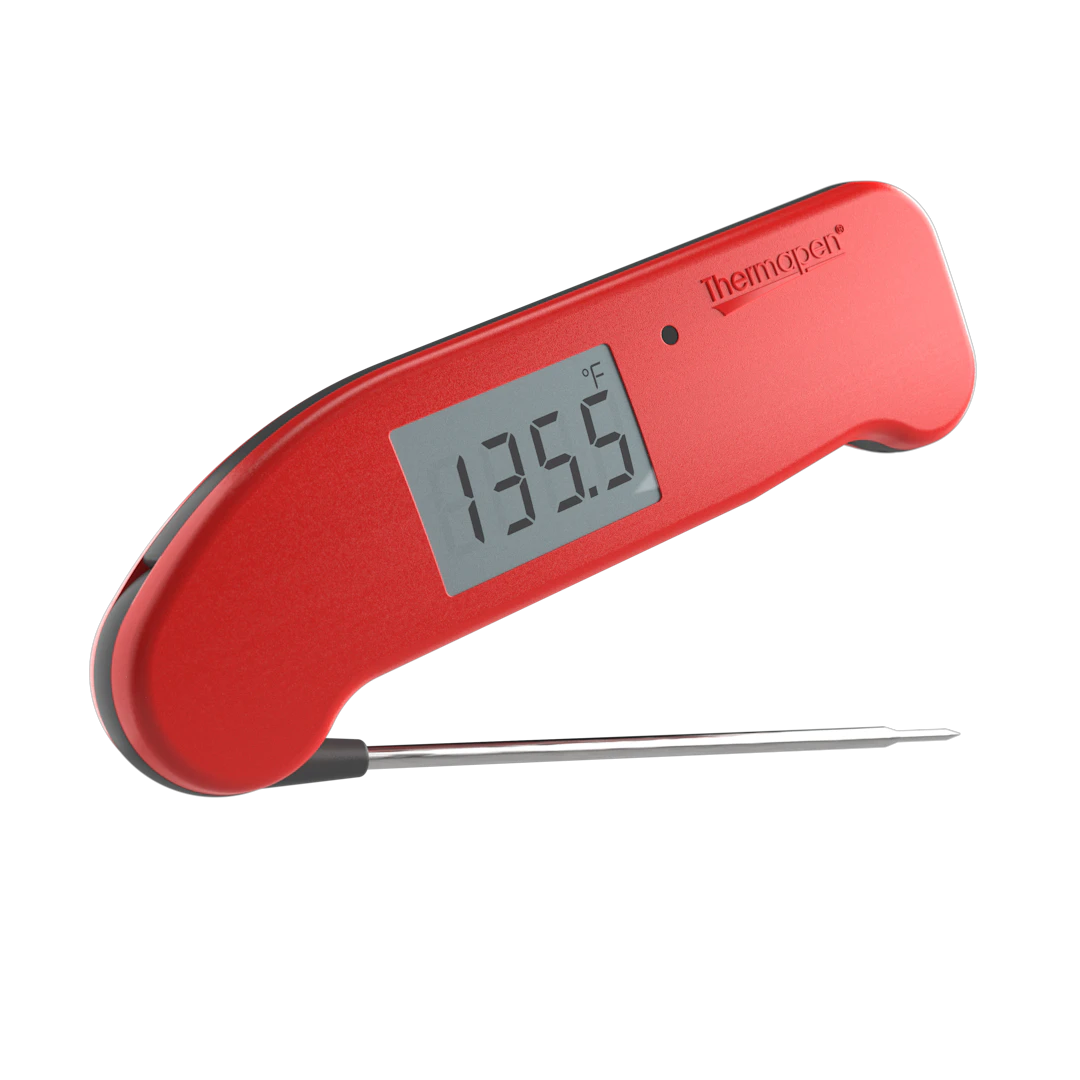
Right before you start to butter-baste, though, you need to start testing your fish's temperature. Use your Thermapen ONE to check the temp all the way through the piece of meat. The final, finish internal temperature of the halibut is 130°F (54°C)—after the easy-melt collagen has melted and the fish is flaky. However, in this high-heat cook, there is going to be some carryover cooking. So we're looking for a pull temp of 120°F (49°C), when you see no temperature below that on your Thermapen ONE, get your fish out of the pan to rest.
If you do it right, you'll end up with fish that is flaky while still being moist and tender. Give it a spritz of lemon juice and enjoy!

In the end, cooking a piece of fish like this is almost exactly like cooking a steak of the same shape. High heat (IRK-2), lots of flipping, some butter, and get it out of the pan at the right temperature (Thermapen ONE) and you've got it in the bag. We hope you try it out soon. This is the kind of thing you can pay real money for at a restaurant but you can make fairly inexpensively at home, and you definitely should! Happy cooking.

For more on cooking fish and seafood, check out our post on fish and seafood temps!


0 comments